
Pergola, sun, shears: a field day with our semi-autonomous robot
Notes from a single eight-hour shift in Frudova's pergola: 80 milliseconds per decision, 25 km/h gusts, exposure bracketing under midday sun, and the three failure modes we hadn't seen before.
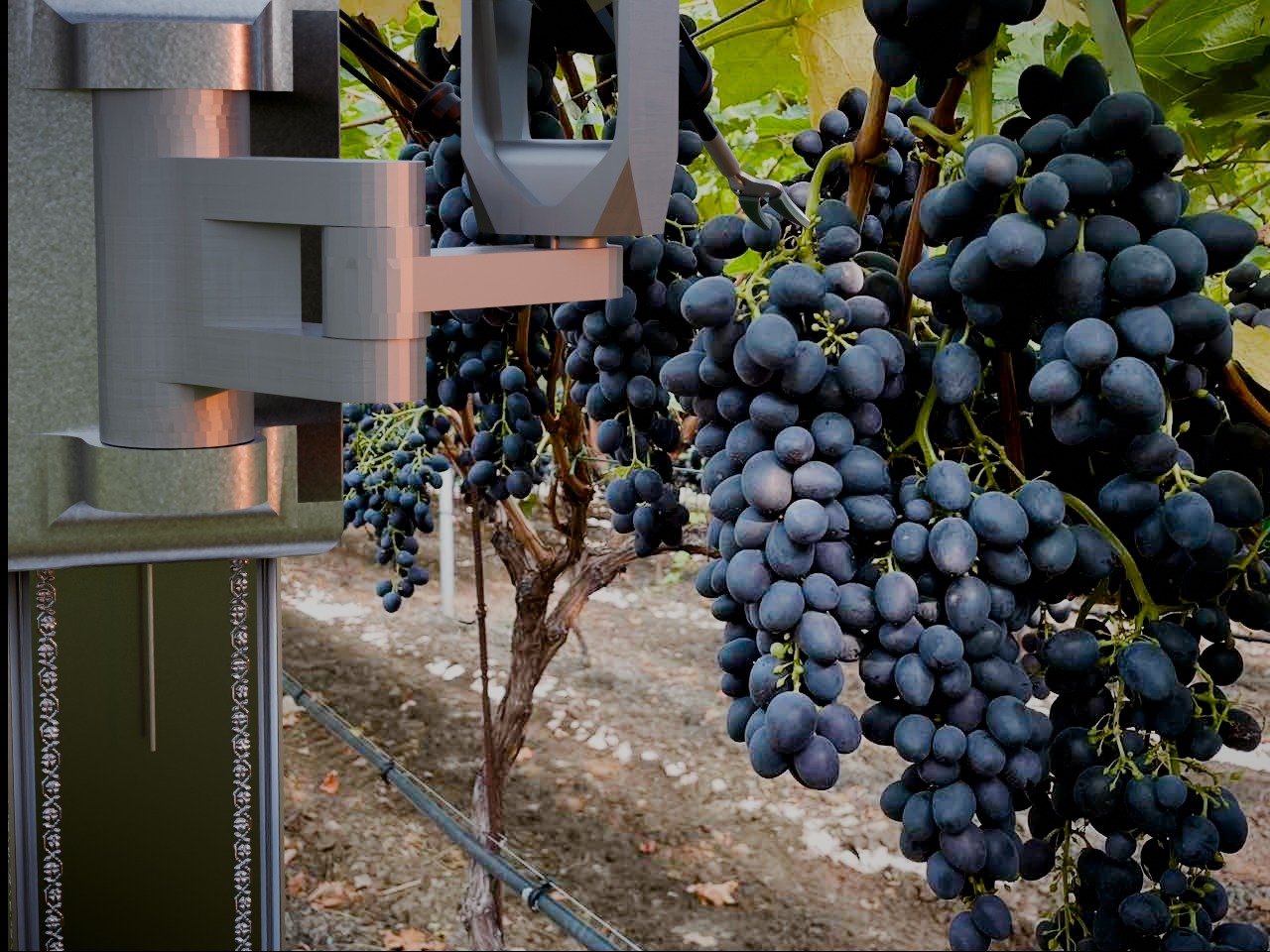
06:18 — first row, eastern light. The robot is faster than the operator at this hour. Cold leaves are stiff and the clusters hang clean. We log a 92% autonomous rate for the first 40 minutes.
09:40 — sun comes over the canopy. Stereo perception starts to flicker on dark grapes against bright leaf. We switch on exposure bracketing — three frames, 1/2000 to 1/250 — and merge in the depth pipeline. Autonomy holds at 88%.
11:15 — wind. A 25 km/h gust shakes a row hard enough that the cluster the robot was reaching for is in a different position by the time the shear arrives. The teleop queue picks it up in 220 ms. Cluster cut clean. The lesson: predict where the cluster will be in 200 ms, not where it is right now.
13:02 — lunch in the shade of the prefab. We replay three failure cases from the morning. Two were occlusion (a leaf we couldn't see through), one was a tendril we mistook for a stem. We tag the frames and push them back into the training set the same afternoon.
15:50 — the dataset gets bigger every hour. Every teleop intervention is a labeled hard case. The flywheel is quiet but it's real: the robot tomorrow will be 0.3% more autonomous than the robot today, on this exact pergola, in this exact light.
18:00 — last crate. 1,840 kg harvested. Three operators on call across two time zones. One robot. One data stream that didn't exist last week.
This is what the field looks like. Not a demo, not a slide. Eight hours, one row, and a small machine that gets a little less wrong every day.